Nature vs Man
Man has continually played with nature. Agricultural crops, as we know them today, are essentially manmade: they are the product of the breeding work of farmers and breeders over thousands of years.
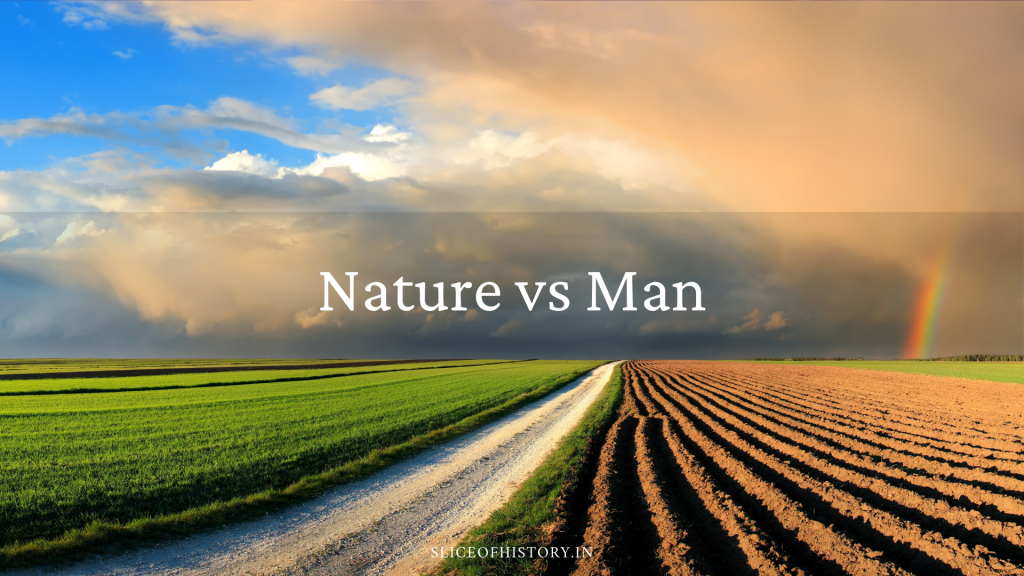
A common refrain one hears today is how man has gained such control over nature that he has started playing God. We live in an age of rapidly evolving technologies some of which seemed to defy the natural order. This can be deeply unsettling especially when many of these technologies have had a deleterious environmental impact. The world seems increasingly artificial and there is often a yearning to revert to an earlier pristine age when everything was in harmony with nature.
The manner in which our food is grown is a special area of concern. Modern agriculture with its use of Industrial fertilizers, pesticides, hybrid seeds and genetically modified organisms (GMOs) is viewed with scepticism. In everyday conversations many health concerns – obesity, cancer, infertility – are often attributed to the use of these technologies. There is a great longing to return to the time when food was grown naturally. This explains to a large extent the growing popularity of organic food. Nothing makes a person feel better than the thought of consuming fruits and vegetables, in their pristine form, plucked fresh from unspoiled farms untouched by human intervention.
Perceptions often play a far more important role than facts in shaping human behaviour. It would surprise most people to learn that majority of the foods that we consume today are not how nature intended them to be – not even the most wonderful organic fruits and vegetables which we so cherish that we happily pay a hefty premium to buy them . Human intervention over ten millennia has changed most foods beyond recognition. The use of modern agriculture techniques are only the latest instance of man playing God. Ever since man moved away from being a hunter-gatherer he has continually played with nature.
To comprehend the extent of human intervention in modifying crops, one requires an elementary understanding of agriculture. All crops that we know today originated from their wild relatives. A wild relative is a plant species occurring in the wild from which the crop was domesticated. Perhaps the word natural, in the agriculture context, is most applicable to these wild relatives. However, agricultural crops, as we know them today, are essentially manmade: they are the product of the breeding work of farmers and breeders over many generations. Through a process of hit and trial famers domesticated these wild plants. Undesirable traits of wild plants were bred out and desirable traits were bred in. For instance, one such trait in cereals such as wheat and rice is the shattering of seed heads prior to maturity. It is crucial in wild plants as the fallen seed propagates and ensures continuity. In domesticated agriculture crops this is an undesirable trait as the early shattering of the seed does not allow it to achieve its full grain size thus making it unviable for consumption. Farmers through a slow process of selection and breeding achieved larger grain size.
A stark example of how God’s creations have been altered beyond recognition is the case of the potato, possibly the most widely consumed vegetable in the world. God, it appears, did not destine potato for human consumption. Wild potatoes originated in the inhospitable terrain of the Andean mountains. According to an article on the history of the potato by Charles Mann in the Smithsonian magazine “Wild potatoes are laced with solanine and tomatine, toxic compounds believed to defend the plants against attacks from dangerous organisms like fungi, bacteria and human beings. Cooking often breaks down such chemical defenses, but solanine and tomatine are unaffected by heat. In the mountains, guanaco and vicuña (wild relatives of the llama) lick clay before eating poisonous plants. The toxins stick—more technically, “adsorb”—to the fine clay particles in the animals’ stomachs, passing through the digestive system without affecting it. Mimicking this process, mountain peoples apparently learned to dunk wild potatoes in a gravy made of clay and water”. Eventually mountain people, through a process of selection, bred out the toxic traits. A toxic plant of humble origins, growing in an inhospitable mountainous terrain, went on to become the most popular vegetable in the world. Nature’s design was dramatically altered by human ingenuity.
Carrot presents another striking case of human intervention. The orange carrot that is so cherished as a health food is not “natural”. Wild carrots are white or pale yellow in colour. They were first domesticated in Afghanistan and its surrounding areas nearly 1,100 years ago. These domesticated varieties, known as the eastern-type cultivated carrot, appeared in two colours – purple and yellow. Carrots subsequently found their way into Europe which is considered as the home of the western-type cultivated carrot. Orange carrots, it is generally regarded, originated in Netherlands in the seventeenth century through a process of mutation and selective breeding of the yellow variety. Farmers have displayed an amazing ability to play around with the colours of nature. The orange carrot, which has gained much fame as a health food outshining all its other cousins – purple, white and yellow, is entirely a product of human creativity.
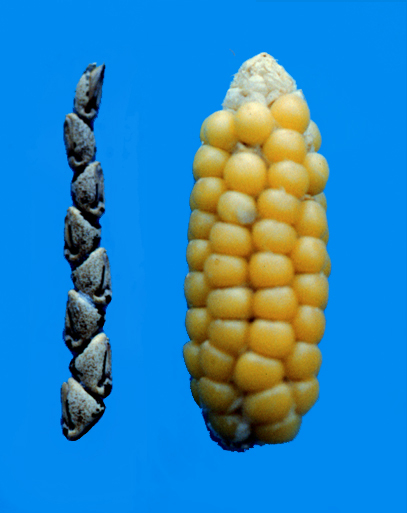
Corn perhaps exhibits the most visually stark form of human intervention. It has descended from its wild ancestor, teosinte, which is a lowland wild grass. Corn bears little physical resemblance to teosinte. The difference in grains is most striking. The teosinte ear is encased in a hard outer covering and each ear contains only 5 to 10 small grains. The corn ear, by contrast, contains hundreds of bright yellow grains without a hard covering. Mexican farmers domesticated teosinte by a process of selective breeding nearly 7000 years ago. The wild grass with small, dark grains was transformed into modern corn with its succulent yellow grains. Spanish conquerors spread corn to the rest of the world and today it is the second most cultivated crop in the world, in terms of acreage, after wheat.
The purpose of listing these stark examples was to illustrate the extent of human intervention in agriculture over millennia. If natural foods are defined as those which are derived from crops that are untouched by human intervention then almost no food would qualify as being natural.
Agriculture proceeded at a languid pace till the onset of the 20th century. As explained, for almost 10,000 years farmers themselves acted as amateur breeders and plant scientists learning to make crops suitable for human use through a process of hit and trial. This can be described as the pre-modern phase of agriculture. The modern agricultural phase, which involves the use of synthetic fertilizers, pesticides, hybrid seeds and GMOs, began in the 20th century. It was as much a result of the increasing pressure to feed a rapidly growing population as it was a contributory factor to helping the population grow. The languid march of millennia of agriculture development gave way to a century of frenzied technological progress in agriculture. Food production increased manifold in 100 years. This rapid pace, the consequences of which are still being evaluated, resulted in acute scepticism about these technologies. The world seemed increasingly artificial and hence there was a desire to return to nature. This was perhaps a yearning to return to a pre-modern agriculture phase which was associated with being natural. But, as this article explains, this phase itself was unnatural.
When viewing our modern diet it is important to adopt a balanced and rational approach. Almost all foods we eat today, organic or otherwise, are tainted by human intervention and are far removed from God’s original creations. What is important is not the perceived naturalness of a food but its established safety and health benefits. Vilifying foods, with a proven safety record, which have been made using modern agriculture techniques, is irrational. It is as irrational as idolizing all foods that are natural or organic.
There is the story of a man, a great believer in all that is natural, who was dying but appeared very happy. A surprised crowd of well-meaning people surrounded him.
“What makes you so happy even though you are dying?” they asked
“A snake bit me,” he replied.
The crowd was even more surprised.
“But why does that make you happy?” they asked
“The poison is natural, it’s organic, it’s so healthy,” he replied before dying.